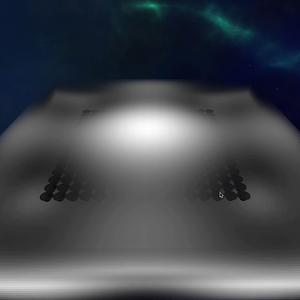
Fluid Simulation OpenGL Engine

OpenGL Volume Rendering Engine for Designing Visual Displays and Acoustic Fields in Immersive Environments

Summary

This project is cross disciplinary, combining advanced computer graphics with computational physics as an exploratory tool for exploring fluids (gasses) in a 3D environment. It was built with the capability of a scientific research tool, but was made out of need for a tool to visualize density graphs of theatrical fog for visual displays and acoustic fields. It was developed due to lack of off-the-shelf tools suitable for immersive volumetric inspection.

In terms of technology, the engine is built with OpenGL in C++ with an implementation of 3D volume rendering- similar to how medical imagery is stored with many 2D slices. I built this software with the assistance of an OpenGL 2D renderer provided by Dr. Zoe Wood.

Key Contribution: Designed and implemented a custom OpenGL-based real-time volume rendering engine for interactive exploration of 3D density fields. Enabled real-time inspection of volumetric data, including inside-the-volume inspection, gradient fields, and particle flow—to support immersive display design.

Skills

OpenGL  ▪︎ Real-Time Rendering Pipelines ▪︎ 3D Volume Rendering ▪︎ Interactive Camera View and Control ▪︎ Density Field Visualization ▪︎ Gradient Field Computation ▪︎ Computational Physics ▪︎ Interactive Tool Development ▪︎ Scientific Visualization Tooling ▪︎ Visualization for Experiential Displays ▪︎ C++

Highlighted Role

Details:

Full Demo

Full Demo

Shown here is a short demo of the software followed by explanations of some of the componential functionality taken from the documentation.

Going Into the Fog

Unique to this software is the ability for the user to move the perspective to inside the simulation and visualize the inner workings of the density field.

This was a very important consideration for immersive environments.

Volume Rendering Control

A perfect extension of volume rendering is the ability to view smaller areas of interest in a particular direction. This is made possible because the rendering is built on slices natively, and is helpful in understanding the inner fields.

Y-Axis Control

The user has full, real time control over the area of interest.

Gradients-Single Axis

If a user is interested in the behavior along a specific axis they can view the gradients in that axis.

Gradients- 3D

Also included is the functionality to view 3D gradients from any angle. 

Gradients-Single Axis

If a user is interested in the behavior along a specific axis they can view the gradients in that axis.

Physics Engine

Built in to the functionality is the simulation of both massless and variable weight particles free-flowing in the density field. This is useful for understanding the direction of travel, or in some cases, intentional manipulation of objects in the air.

Smiley Face

Included as a preloaded simulation is a procedurally generated smiley face… sort of. This is the unofficial logo for the software.

You may also be interested in:

boX: Custom Deep Learning Server

An Ubuntu Server Configuration for Remote Deep Learning Tasks

‘Deep Gerchberg-Saxton’: A Physics Informed Neural Network Architecture

A novel deep learning approach to Volumetric Phase Retrieval problems; applied to immersive displays

Acoustophoresis: Acoustic Levitation in Volumetric Displays

R&D in sound-driven object levitation for immersive spaces

Founder

Inventor of Core Patent-Pending Technology of a Speaker Manufacturing and IP Company

Life in India

A documentation of my time and life at a university in Bangalore, India.

Pastel and Mixed Media Impressions

A collection of a recent movement in my art: impressionistic and figurative works with oil pastel, ink, and water soluble pastel.

Top

Nathan Gollay Portfolio